On 7 October a plumber posted on r/Plumbing about their third unpaid trip to the same leaking toilet. Three visits in, there was still no clear record that settled what was wrong or what had already been done.
The next day, a homeowner on r/Plumbing said they had texted their plumber about a fault with a pedestal sink hours after it was installed, and asked whether it counted as a warranty callback.
A week earlier, on 2 October, another homeowner disputed a plumber's claim that the customer had caused a leak under their kitchen sink. Neither side had a shared record of the work to point to.
Three posts, one week, the same gap. Nobody could show what was done, what was tested and what the customer saw.
What a callback really costs you
A callback is rarely just one more trip. It is the drive, the time on site, the job you pushed back to fit it in, and the text thread that gets shorter and colder each time.
When there is no record, every conversation starts from memory. The customer remembers it one way, you remember it another, and the argument is about who is right instead of what is wrong. That is how good work ends in a bad review.
The homeowner with the pedestal sink asked the question most customers are thinking: is this covered? If you have not answered that before the job starts, you end up answering it in a text at 7pm, with no policy to point to.
The fix, in the order you would do it
The idea is simple. A callback is its own job, with its own record, not a message buried in a thread. Here is the flow, then each step.
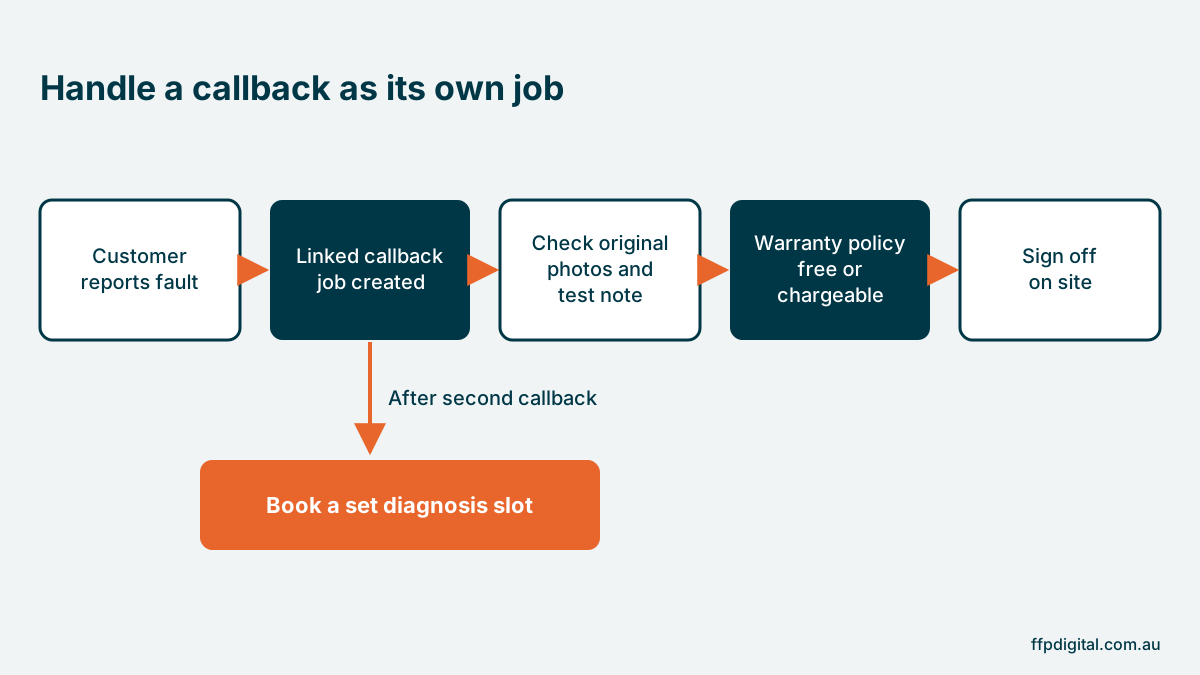
Each callback becomes its own job with a record, a clear warranty rule and a sign off.
Step 1: make the callback a new job, linked to the first
When the customer reports a fault, do not just reply "no worries, I'll swing by". Create a new job in your job software (ServiceM8 or whatever you use) and put the original job number in the description so the two are tied together.
If your software lets you set a category or tag, make one called Callback and use it every time. That one habit is what lets you count them later.
Reply to the customer with something like:
Thanks for letting me know. Your return visit is logged against the original job. Can you send a photo of what you're seeing? A time will be confirmed today.
One clear question, one clear next step. The customer knows it has been taken seriously.
Step 2: check what was recorded last time
Before you go back, open the original job. Look at the photos and the notes. What was tested? What did it look like when you left?
This is only useful if the photos and notes exist. So from this week, on every job, take completion photos and write a short test note before you leave. Keep it plain:
Pressure tested, no leaks after 10 min. Pan sealed and fixed. Shown to customer.
A few lines and a few photos, saved to the job, not just your camera roll. That record is what settles the third callback and the "you caused it" argument.
Step 3: get a sign off on site
At the end of each visit, including the callback, walk the customer through the work and get them to sign off on site. Most job apps can capture a signature on your phone. If yours cannot, a short message the customer replies to with "all good" is better than nothing.
The point is not to trap anyone. It is so that you both have the same record of what was working when you left.
Step 4: write a one page warranty policy
Put down in plain words what a free return covers and when a visit becomes chargeable. Keep it to one page and put it on every quote, so the customer has seen it before you start.
Sample wording you can adapt:
If work completed under this quote fails because of workmanship or parts supplied by the business, the return visit and fix are free. If the fault is caused by something else (damage, other trades, items not part of the job), the visit is charged at the standard call out rate. Any findings are shown to the customer before a charge applies.
Now the pedestal sink question has an answer before it is asked, and you are not making the call in the heat of a text thread.
Step 5: after the second callback, stop dropping in
If a job comes back a second time and you still cannot explain why, do not squeeze in another quick look between jobs. That is how you get to a third trip with nothing settled.
Book a set diagnosis slot instead, with enough time to find the cause properly. Tell the customer plainly:
Rather than keep patching this, the next step is a proper diagnosis visit. Thursday morning is set aside to go through everything.
Customers losing patience usually want to see that you are taking it seriously. A booked time does that better than another rushed visit.
Count them every month
Once callbacks are their own jobs with their own tag, you can see how many you had last month, which jobs they came from and who was on them. That turns a vague feeling of "we seem to go back a lot" into a number you can do something about.
The catch is that the count is only as honest as the tagging. If the callback tag is optional, or the same question gets asked in two places, once on the job and again on a form, people fill it in differently each time and the monthly number tells you nothing. One field, in one place, that cannot be skipped.
Pick a day at the start of each month to look at the number. If one type of job keeps coming back, that is where to look first.
Back to that third trip
The plumber on their third visit to the same toilet was not short on effort. They were short on a record. Start the next callback as its own job, with photos, a test note and a sign off, and the next time someone asks what was actually done, you can show them.