Software gets sold on the signup and delivered on the setup, and the gap between those two things is where most of the money goes missing. You pay the same monthly bill whether you use all of ServiceM8 or the four screens you learned in your first fortnight. Nobody at ServiceM8 rings to tell you that something you are already paying for would have saved you a day this month.
ServiceM8 15 was released on 18 September 2026. It is a big release, and the keynote runs through all of it. The point of this post is not the feature list. It is that a release like this widens the gap rather than closing it, because the new things arrive switched off, or switched on and unconfigured, and reading release notes is nobody's job in a trade business.
Office Agent is the clearest example
Office Agent moved from preview to generally available in ServiceM8 15, which means it is now on for all customers rather than a trial group. Among the things ServiceM8 demonstrated it doing: answering questions about a job in context, finding your most valuable unanswered quotes and drafting the follow-ups, turning outstanding balances into a report, and drafting a quote or an invoice from the job data, recorded time and diary notes already sitting in the account.
Read that second one again, because it is the one with money attached. Most trade businesses have a pile of quotes that went out and never got a yes or a no. Not because anyone decided to let them go, but because following them up is a job that never makes it to the top of the list. The capability to find the valuable ones and draft the chase is sitting in the subscription you already pay for.
The obvious worry is whether it goes off and does things on your behalf. It does not. Actions are proposed and require approval. You see what it wants to send before it sends it.
There is also a recurring task version, where the agent runs on a schedule, for example a weekday morning review that prioritises the jobs needing attention and prepares the next action on each. When you decline an action and give a reason, that reason is remembered and applied on later runs. It reads your Knowledge articles as its procedure manual, which means the quality of what it does is downstream of how well your own processes are written down.
Why nobody turns it on
Three reasons, and none of them are that the owner is lazy.
The first is that features arrive silently. An app updates overnight. Nothing in the daily run of the business changes to tell you that something new is available, and the only people who read the release notes are the people whose job it is.
The second is that setup is real work and it belongs to nobody. Turning Office Agent on takes a minute. Deciding what it should prepare, what needs your approval, what it should leave alone, and writing the Knowledge articles it reads as procedure, that is an afternoon of thinking about how your business actually runs. It is the kind of work that is always less urgent than the job in front of you.
The third is that the cost of not doing it is invisible. A quote that was never followed up does not appear anywhere as a loss. It just is not there.
Android parity closes an old excuse
Android reached full parity with iOS in this release and lost the Light badge it used to carry. If anyone in your crew was told at some point that they needed an iPhone to use ServiceM8 properly, that is no longer true, and a mixed fleet is now a normal way to run.
This one matters more than it looks, because "half the crew cannot do it on their phone" is the reason a lot of businesses gave up on a workflow and went back to paper. If that was you, the thing you gave up on may be worth another look.
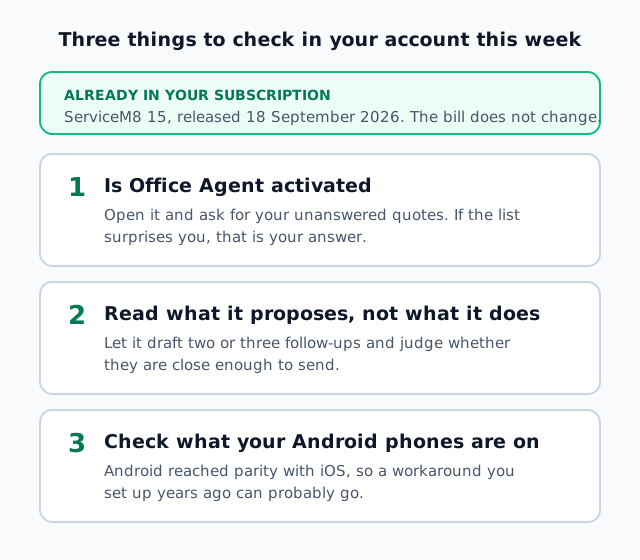
Three things to check this week
Not a project. Three things you can look at in your own account between jobs.
- Is Office Agent activated. Open it and ask it for your unanswered quotes. If the list surprises you, that is the answer about whether it is worth half an hour.
- Look at what it proposes, not what it does. Let it draft two or three follow-ups and read them. You are judging whether the drafts are close enough to send, not handing anything over.
- Check what your Android phones are on. If anyone is on a reduced setup or has been working around the app, the parity change means that workaround can probably go.
None of that is a purchase. It is checking what you are already buying.
The honest version
You are not going to use all of ServiceM8, and you should not try. Most of it will never apply to how you work. But the distance between the four screens you learned in your first fortnight and the parts that would actually give you a day back is bigger than most owners think, and it grows every time there is a release.
The thing to take from ServiceM8 15 is not that you should go and learn a feature list. It is that the bill does not change when the product gets bigger, so the only variable you control is how much of it you have set up.